Bring order to your work
Some managers and owners care that work is set up neatly: everything in one place, run by clear rules, nothing lost, nothing done by guesswork. Not out of distrust of the team, but because order saves time, reduces mistakes and makes results predictable. This page is about how to bring such order to LadVen OS — and keep it — without turning it into bureaucracy.
The problem it solves
When work rests on verbal agreements and scattered tools, order is impossible to hold: everyone has their own way of doing things, information gets duplicated and drifts apart, and quality depends on exactly who did the work. Any attempt to "bring order" by hand falls apart within a week, because there is no single home and no shared rules.
This scenario closes the gap like this: all the work is run in one space by repeatable rules — standard tasks and checklists set the standard, gates keep important things from being skipped, and a single history shows what was done and how.
How it works in LadVen OS
Order is built from blocks that set and maintain the standard:
- A single space — tasks, clients, documents and conversations in one place, not in scattered tools.
- Templates and recurring tasks — repeating work gets set up the same way and on time.
- Checklists — the standard for "what counts as done" inside each task.
- Protective gates — they won't let you move a stage forward or close a task without meeting a condition.
- A single history — you can see who changed what and what happened, without reconstructing it from memory.
- Access rights — everyone has their own zone, without the chaos of "everyone sees and touches everything".
Order without bureaucracy
Good order isn't measured by the number of fields and approvals. Standardize what repeats and where mistakes are costly (intake of a request, handoff into production, closing), and leave one-off work flexible. Then the rules help rather than hinder, and the team won't start working around them.
How it looks in practice
Take a typical point of disorder — taking in and fulfilling a request. Before: the request came into a chat, someone picked it up (or didn't), did it their own way, forgot to attach the certificate, and no one remembers what stage it's at.
With order in place, the same path is predictable. The request turns into a task from a template — with a ready checklist of "what must be done" and fields you can't leave empty. The assignee follows the checklist, not their memory. A protective gate won't let you close the task without a result file. Recurring requests are created as a recurring task on their own, at the right moment. All of it is visible in the automation hub: which rules and templates are running, who owns them, what hasn't run in a long time.
Order rests not on the discipline of individual people but on the system: a new employee works the same way as an experienced one, because the standard is built into templates, checklists and gates.
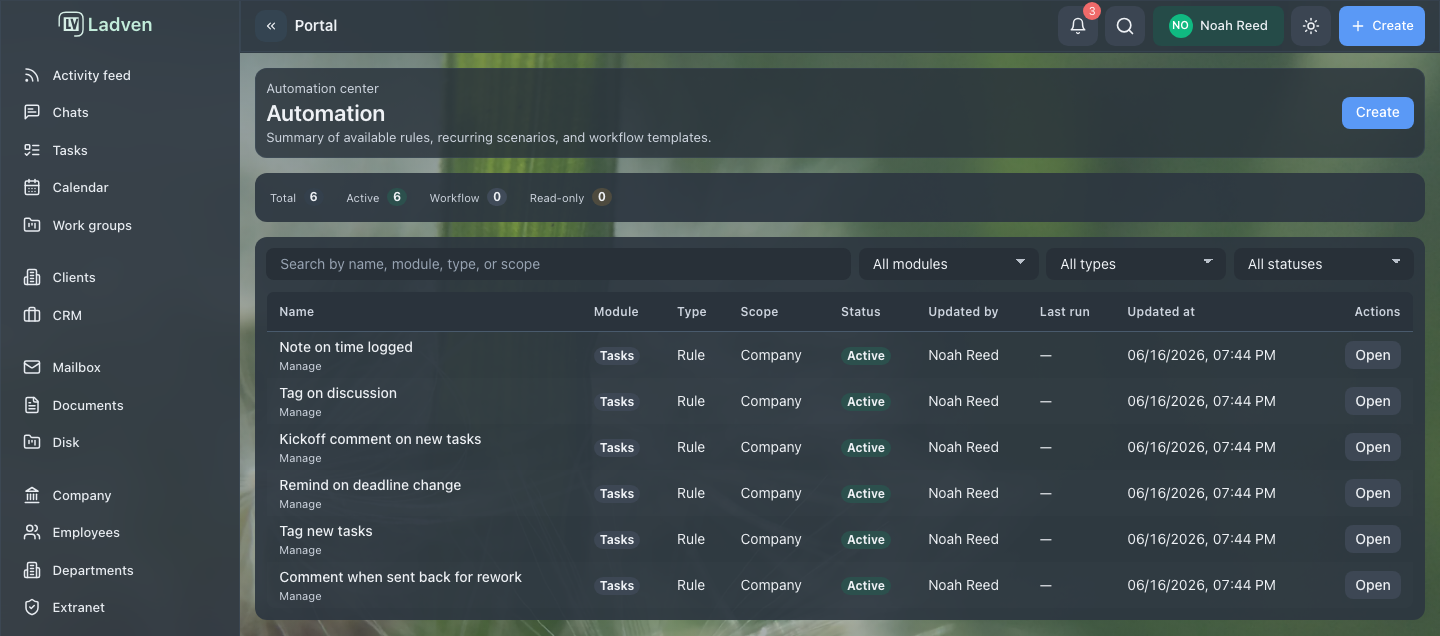
All rules and templates in one place: the standard lives in the system, not in people’s heads.
What the business gains
- work is set up the same way, not "each person their own way";
- nothing gets lost: every unit of work has a place, an owner and a standard of readiness;
- quality stops depending on exactly who did the task;
- new employees quickly understand how things are done here;
- order is maintained by the system, not by the manager's willpower.
Implementation checklist
- Bring tasks, clients and documents into one space.
- Describe repeating work as task templates and recurring tasks.
- Set checklists with a "what counts as done" standard for standard tasks.
- Set up protective gates at key transitions (for example, you can't close without a result file).
- Set up access rights: everyone has their own zone of responsibility.
- Agree that you standardize what repeats and leave one-off work flexible.
What to avoid
- Don't impose order by hand on top of scattered tools — it will fall apart; you need a single system.
- Don't turn order into bureaucracy: people will work around extra fields and approvals.
- Don't standardize one-off work — the standard is for what repeats.
- Don't leave the "standard" only as words — lock it into templates, checklists and gates.
How to measure the result
- the share of repeating work that runs by templates and checklists;
- the share of tasks with a clear definition of done;
- the number of mistakes and rework caused by "forgot / did it their own way" — it should go down;
- the speed of onboarding a new employee.
Where to start
- Tasks — a single home for the team's work.
- Templates, recurring tasks and automation — set a repeatable standard.
- Checklist in a task — the "what counts as done" standard.
- Pre-operation gates — don't let important things be skipped.
- Automation hub — keep all rules and standards in one place.
Request a demo
Want to see what real order looks like on a ready-made environment with templates, checklists and gates? Request a demo — we'll show you a configured demo portal and help you move your working rules onto it.