Work gets lost between people
The most frustrating losses aren't where someone failed, but where work fell through "between" people: the manager handed it to production verbally, production assumed accounting would clarify it, accounting never knew about it at all. Everyone was sure it was on someone else. The more people and departments there are, the more often "I thought you had it" surfaces. This page is about how to close the gaps at the seams.
The problem it solves
Work gets lost at the handoffs: between manager and assignee, between departments, between shifts. The cause — there's no single place where the owner, the agreement and the next step are recorded. A verbal handoff leaves no trace, context gets lost in chat, and when something drops, finding someone to blame matters more than reconstructing what actually happened.
This scenario closes the gap like this: every handoff of work is captured as a task or a linked object with a single owner, a clear result and a next step, and a single history shows who handed off what and when — so nothing falls through at the seams.
How it works in LadVen OS
Handoff failures are closed because work always has an owner and a trail:
- A single owner — every task and request has someone it's currently on, with no blurring.
- Handoff as an action — work is passed on by reassigning the owner or by a linked task, not "by word of mouth".
- A next step — it's always clear what should happen next and who it depends on.
- Links between objects — task, deal, document and client are linked, so context isn't lost in the handoff.
- A single history — who handed off and changed what and when, without hunting for the culprit from memory.
- Notifications — whoever the work is handed to finds out about it right away.
Where it usually falls through
The usual seams: sales → production, request → accounting, shift → shift, a "shared" inbox or chat with no assigned owner. In LadVen OS each such handoff gets an explicit owner and is recorded in the history, so "I thought you had it" stops working.
How it looks in practice
A classic failure: the manager closed the deal and "handed it to production" — by posting in a shared chat. Production assumed accounting would clarify the details, accounting didn't know about it. A week later the client calls: where's my order? And the search for someone to blame begins instead of getting the work done.
With the system, a handoff is an action, not a remark in a chat. The manager creates a task for production with a result, a deadline and a link to the deal — it immediately has a single owner, and that owner gets a notification. Context travels with the task: from it you can open the deal, the client and the documents, with nothing to retell. The next step is always visible — as long as it exists, work doesn't "hang". And if something does go wrong, the history shows who handed off what and when: people sort out the process, not each other.
The seams between departments stop being black holes: every handoff has an owner, a trail and a next step.
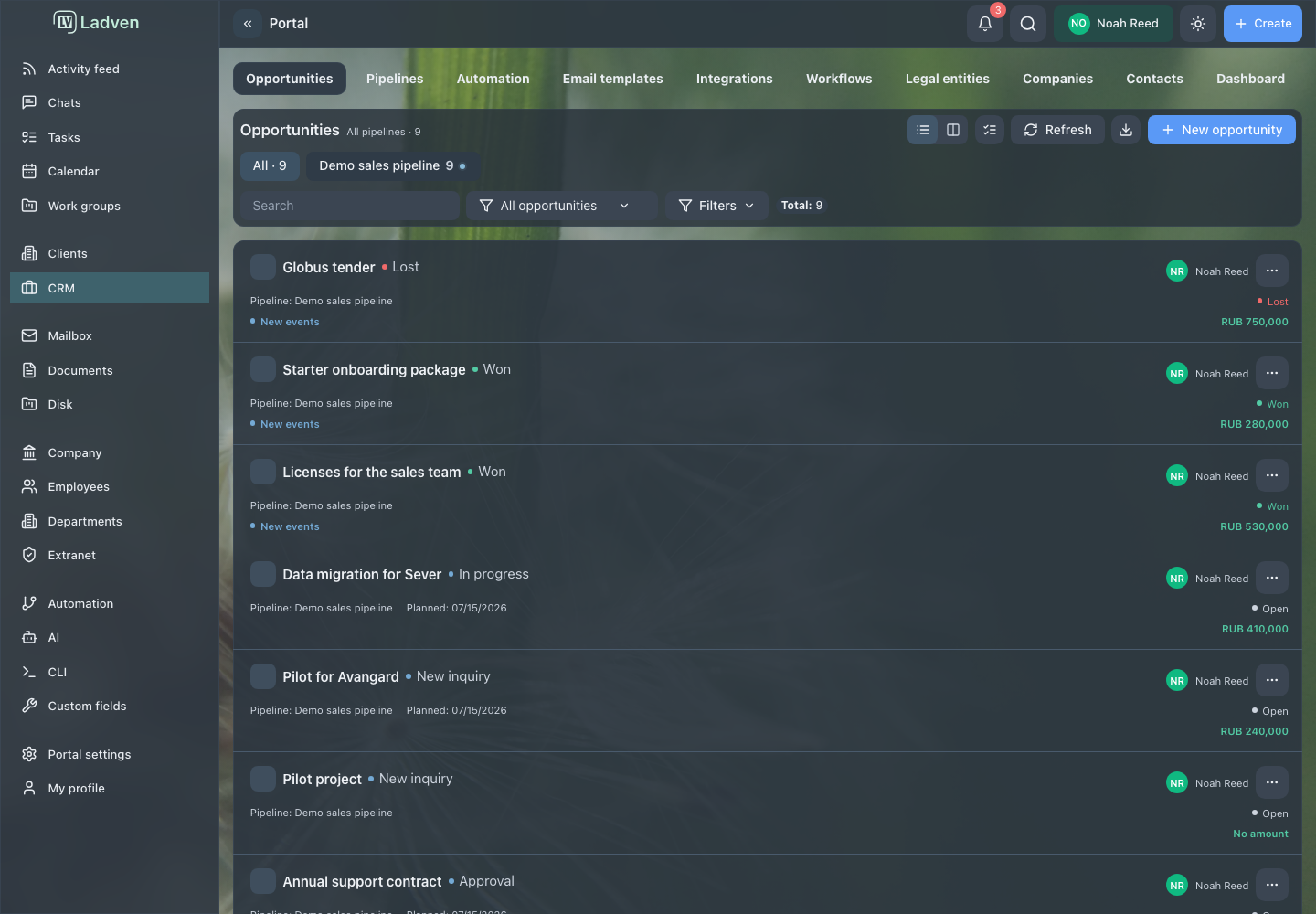
One owner and a next step per deal — so work doesn’t fall through the handoffs.
What the business gains
- work doesn't get lost at the seams between departments and employees;
- every handoff has a single owner and a next step;
- context travels with the task instead of getting lost in chat;
- when reviewing, you can see what really happened, without hunting for the culprit;
- clients and adjacent departments don't suffer from "gaps between".
Implementation checklist
- Identify the key handoffs between people and departments in your process.
- Capture each handoff as a task or a reassignment of the owner, not a verbal agreement.
- Introduce the rule: work always has a single owner and a next step.
- Link tasks to deals, documents and clients so context isn't lost.
- Set up notifications so the recipient learns about the handoff right away.
- Use the history to review failures instead of hunting for the culprit.
What to avoid
- Don't hand off work verbally or in private chat — without a trace, it falls through.
- Don't leave work "with the department" without a specific owner — there will be no one to answer for it.
- Don't lose the next step in a handoff: it should always be clear what comes next.
- Don't use the history review to hunt for the culprit — use it to fix the seam.
How to measure the result
- the share of handoffs captured as a task with a reassigned owner, rather than verbally;
- the number of "lost between people" cases — it should go down;
- the share of tasks with a single explicit owner and a next step;
- the time to review "what happened" after a failure — it should shrink.
Where to start
- Tasks — capture work and handoffs with an owner and a deadline.
- Assigning participants — who is running the work and who it's been handed to.
- Task relations — link a task to a deal, document and client.
- Task activity and history — see who handed off and changed what.
- Manager assignment control — close the gaps at the assignment level.
Request a demo
Want to see how work stops getting lost at the seams, on a ready-made environment? Request a demo — we'll show you tasks, owners, links and history on a configured demo portal and help you move your process onto it.