Everything depends on the owner
A common pain of a growing business: everything funnels through the owner. People come to them with every question, deals don't move without them, they remember what isn't written down, and they fight fires instead of building the business. Taking a vacation feels risky — without them, everything stalls. This isn't about distrust of the team; it's the absence of a system in which work can move without the owner's hands-on involvement. This page is about how to stop being the bottleneck.
The problem it solves
When knowledge and decisions live in the owner's head, the business can't scale: the team can't act on its own because the rules, context and priorities aren't recorded anywhere. Any delegation "by word of mouth" comes right back, because there's no clear result, no place where progress is visible, and no way to check on it without personal involvement.
This scenario closes the gap like this: work is delegated as tasks with a clear result and deadline, recurring processes are described and run on their own, and the owner controls by exception — stepping in where it's truly needed, not on every step.
How it works in LadVen OS
Dependence on the owner is removed by moving knowledge and control out of their head and into the system:
- Tasks as delegation — an assignment with a result, an assignee and a deadline, not a verbal request.
- Processes and standards — recurring work is described and runs without manual launching.
- Checklists and templates — the work standard is recorded, not living in the owner's memory.
- Control by exception — the owner reviews overdue and stuck items, not every step.
- A single history and dashboards — status is visible without personal involvement and follow-up questions.
- Rights and roles — the team acts on its own within its zone of responsibility.
What changes for the owner
Instead of being the "single point of failure", the owner takes on the role of system owner: they set the rules and priorities once, and from then on the work runs by them. Time is freed up for growth, and a vacation stops being a threat to the business.
How it looks in practice
Picture this: the owner leaves for a week. In the past that meant a pause — deals didn't get started without them, decisions stalled, questions of "how should we handle this?" piled up.
With the system in place, that same week looks different. An incoming request automatically becomes a deal and a task with an owner and a deadline — a bot creates it by a rule, not the owner by hand. The manager runs the deal through the pipeline: at each stage it's clear what to do next, because it's described in the standard, not in the owner's head. When a tricky case comes up, the employee checks the checklist and the history of similar tasks instead of writing to the owner. The department head sees on the dashboard what's overdue and where the bottleneck is, and steps in selectively.
The owner, meanwhile, opens the portal once a day and looks at the dashboard by exception: most deals are on track, a couple of items need attention — they respond to those in the task comments, without sifting through everything. The business hasn't stalled. When they return, there's no need to "get back up to speed": the history of each task and deal shows what happened, who decided what, and why.
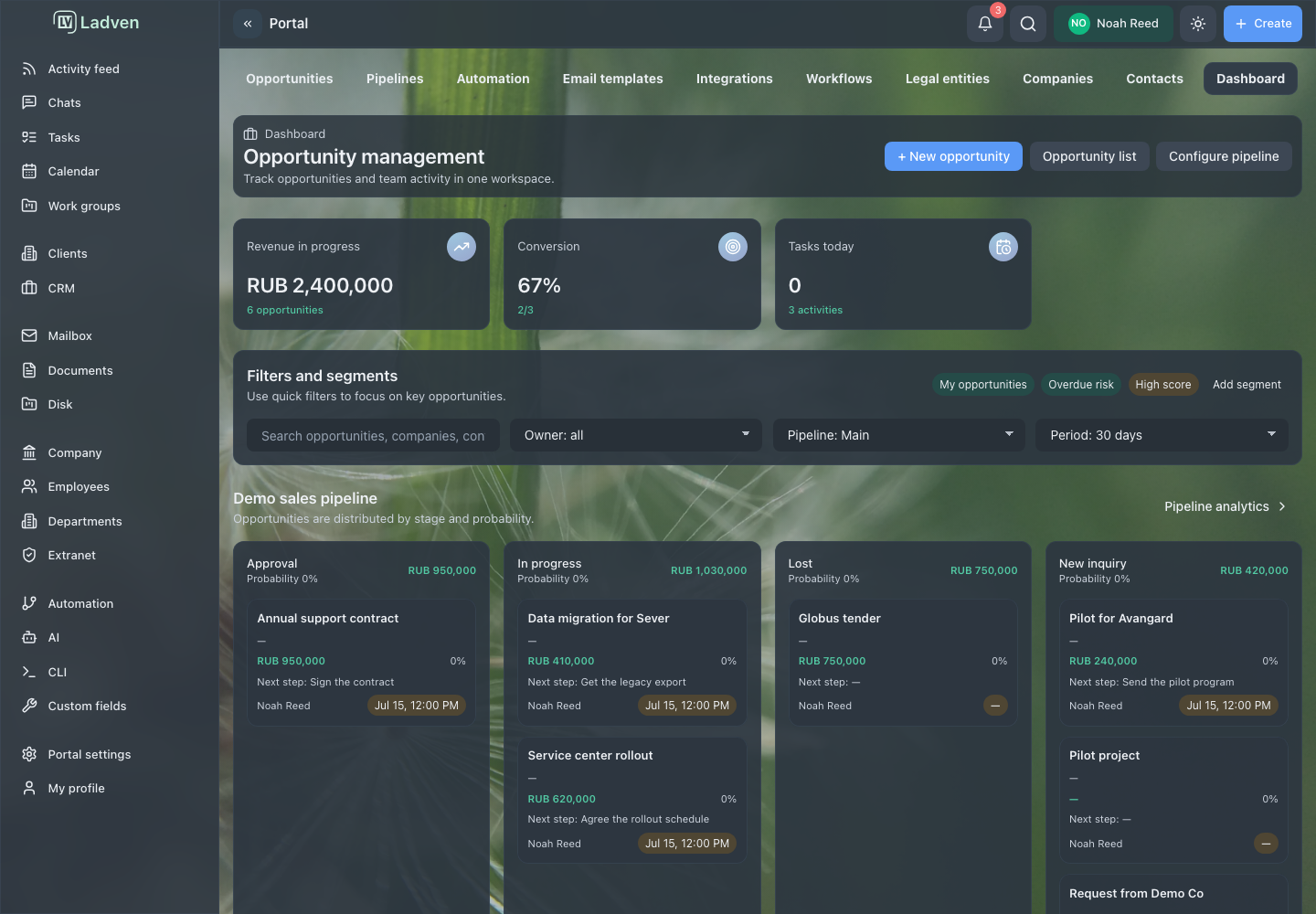
A single glance shows where the money is and what needs attention — no manual reports.
What the business gains
- the business runs when the owner isn't around;
- decisions and context are recorded, not living in one person's head;
- the team acts on its own by clear rules;
- the owner works on growth, not on manual management;
- control is preserved — by exception, not through constant presence.
Implementation checklist
- Write down which decisions and tasks currently go through the owner.
- Turn the standard ones into tasks with a result, an assignee and a deadline.
- Describe recurring processes as templates and standards.
- Lock the work standard into checklists instead of verbal explanations.
- Set up control by exception: overdue, stuck, no next step.
- Hand zones of responsibility to the team through rights and roles.
What to avoid
- Don't delegate "by word of mouth" — without a result, a deadline and a place to check on it, the assignment will come back to you.
- Don't keep rules and context in your head — move them into templates, checklists and processes.
- Don't replace the system with manual control of every step — that makes you the bottleneck again.
- Don't keep for yourself decisions the team can make by clear rules.
How to measure the result
- the share of tasks and decisions that move without the owner's involvement;
- how many questions a day funnel through the owner — it should go down;
- the share of recurring processes that run without manual launching;
- whether the business can run for a week without the owner with no disruptions.
Where to start
- Tasks — delegate work with a result and a deadline.
- Templates, recurring tasks and automation — describe recurring processes.
- Automation hub — so processes run without manual launching.
- Manager control and dashboard — control by exception without being present.
Request a demo
Want to see a business running without the owner's hands-on involvement, on a ready-made environment? Request a demo — we'll show you tasks, processes and control on a configured demo portal and help you move your work onto it.