Fitness studio: clients, trainers, trial sessions, and reminders
This page covers the operating loop of a fitness studio, club, or small training school: a client leaves a request, the administrator schedules a trial session, the trainer receives a task, documents and agreements stay with the work, and follow-ups do not disappear. LadVen OS helps manage clients, tasks, files, deadlines, communication, and follow-up, but it does not replace a dedicated industry system for membership accounting, rooms, equipment resources, or group-class schedules as separate entities.
What Problem It Solves
In a fitness studio, the client journey often breaks between touchpoints rather than during training. A lead leaves a request, but the administrator does not reach them. The client attends a trial session, but the trainer does not pass on the result. Someone should remind the client about the next visit or renewal, but it remains in a private chat. The manager sees the problem only after the client fails to return.
The scenario solves this by keeping the request, trial session, preparation, documents, trainer task, session result, and next contact in one workflow with assignees, deadlines, files, checklists, and reminders.
How It Works in LadVen OS
The scenario is built from existing capabilities:
- Clients and requests — the client card keeps contacts, request history, linked tasks, and agreements.
- CRM and stages — the request moves from new lead to trial session, client decision, next contact, and retention.
- Calendar — trial sessions, consultations, calls, and internal meetings are visible in the team's schedule.
- Tasks — calls, trainer preparation, document checks, session results, and next contacts get an assignee and deadline.
- Files — questionnaires, agreements, instructions, safe attachments, and working materials stay next to the task.
- Checklists — first contact, session preparation, result capture, and follow-up are checked in advance.
- Comments — administrator clarifications, trainer outcomes, and manager decisions remain in the history.
- Reminders — a repeat call, visit check, or renewal becomes a dated task.
Clients, Trainers, and the Next Contact
Every request needs a clear route: who accepted the client, what training goal they have, who runs the trial session, which documents are needed, who records the outcome, and when the next contact is due. Personal training, a small group, consultation, children's class, or online session may each have a different route, but responsibility must stay visible.
If the client reschedules, the task is updated. If the trainer leaves a recommendation after the session, it is recorded in a comment or linked assignment. If a repeat call or renewal reminder is needed, it does not stay in the administrator's memory; it becomes a dated task.
Trial Session and Retention Route
Studio work becomes manageable when the client route is visible step by step: request received, first contact made, goal and format clarified, trainer assigned, trial session confirmed, documents prepared, training outcome recorded, next contact scheduled, client decision captured, repeat visit or renewal placed under control.
Client statuses can be maintained manually: new request, could not reach, booked for trial session, waiting for confirmation, session completed, trainer outcome needed, waiting for client decision, schedule repeat contact, renewal under control. This does not replace a membership system, billing, or automatic room scheduling, but it gives administrators and managers one working context.
Exceptions should become tasks too: the client did not show up, rescheduled, asked for another format, the trainer noted a load limitation, consent or an instruction is needed, the client paused visits, a paid period is ending, or a manager conversation is required. Each case gets an owner, deadline, and comment instead of a verbal "we will remind them later."
Files, Checklists, and Reminders
A fitness studio needs client materials without sensitive data near the work: a questionnaire, agreement, instruction, consent, first-contact plan, session outcome, and internal procedures. When they sit in different chats, the studio loses history and cannot see what was promised to the client.
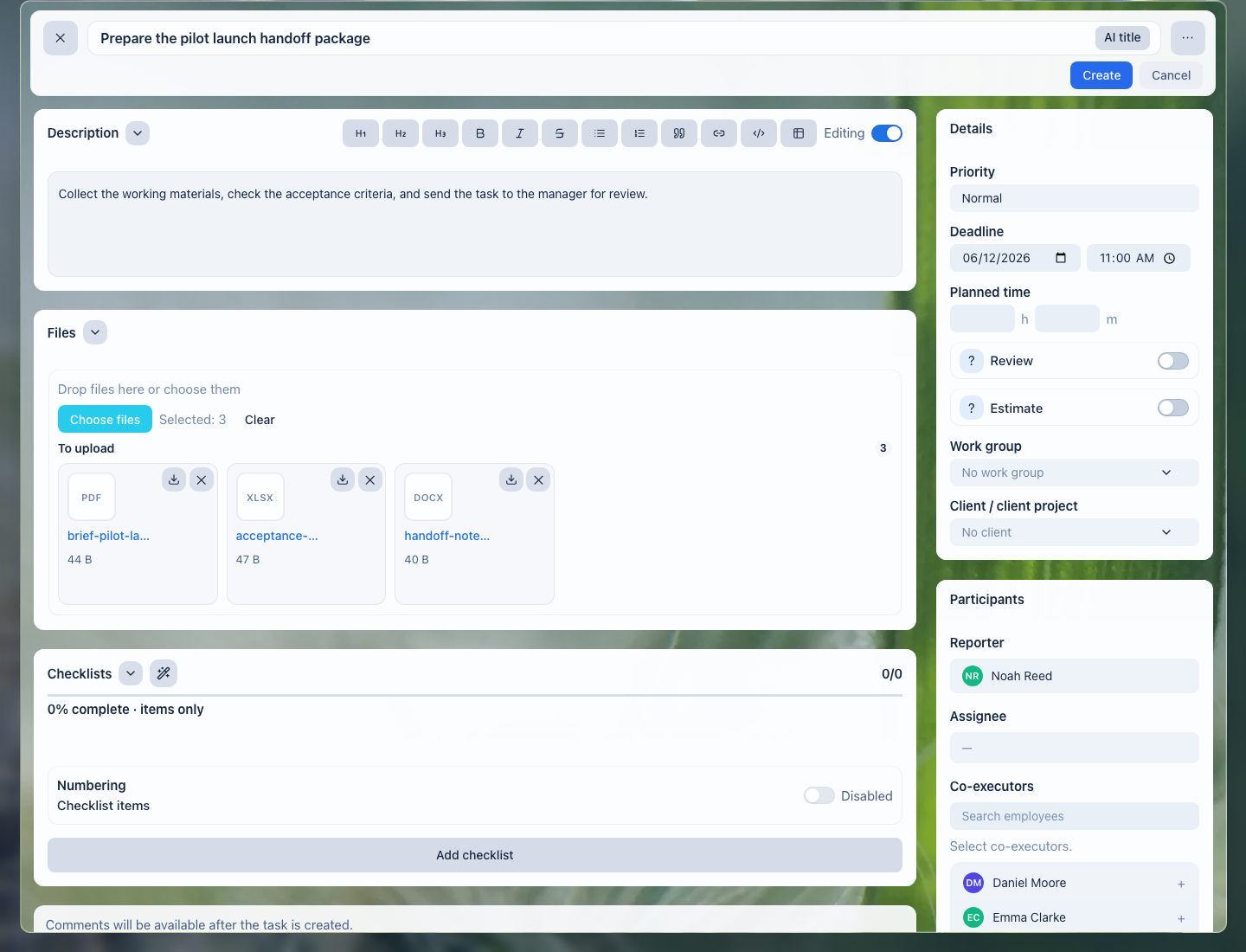
Files stay next to the work: administrator, trainer, and manager see one set of materials.
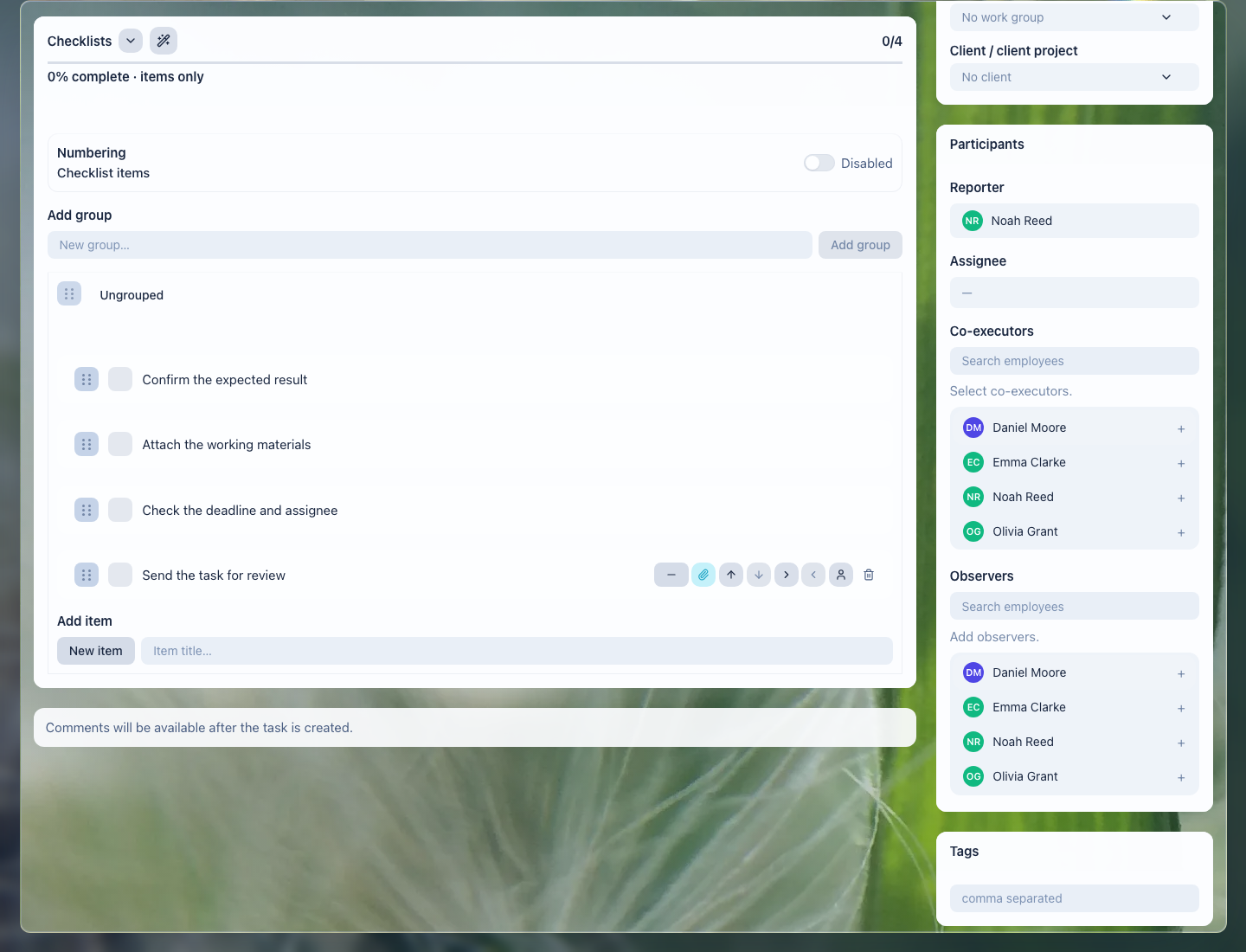
A checklist helps avoid missing contact, preparation, session result, and the next-step task.
What the Studio Gets
- each client shows who owns contact, session, and next step;
- agreements, questionnaires, and instructions do not disappear across phones, email, and chats;
- the trainer passes the session outcome in the work context instead of only verbally;
- the manager sees stalled requests, missed follow-ups, and team workload;
- repeat visits and renewals do not depend on the administrator's memory.
Implementation Checklist
- Split typical scenarios: new request, trial session, personal training, small group, repeat call, renewal.
- Define client fields: goal, format, preferred time, owner, trainer, documents, next contact.
- Create task templates for calls, session preparation, outcome comments, follow-up, and renewal.
- Add checklists: contact made, trainer assigned, documents ready, outcome recorded, next step scheduled.
- Configure manager views: new requests, today, tomorrow, waiting for client, no outcome, no follow-up, overdue.
- Decide separately where membership accounting, rooms, and group-class schedules are managed: LadVen OS can manage requests, tasks, documents, manual client statuses, and communication, while industry accounting may require another process or early access.
What to Avoid
- Do not promise membership accounting, payments, rooms, equipment resources, or group-class schedules as a ready industry system.
- Do not use a manual task status as a replacement for membership billing, access control, or automatic room scheduling.
- Do not store sensitive medical or payment data in tasks if it belongs in a separate controlled process.
- Do not leave the trial-session outcome only in a verbal conversation with the trainer.
- Do not close a request without a result, next step, or refusal reason.
- Do not expose client documents to employees who do not need them for work.
How to Measure the Result
- share of new requests with a next contact assigned by the end of the day;
- conversion from trial session to the next step;
- clients without an outcome comment after a session;
- missed follow-ups and renewals;
- average time from request to first contact and from trial session to client decision.
Where to Start
- CRM clients — keep contacts, request history, and agreements.
- Deals and requests — manage stages from lead to trial session and next contact.
- CRM pipelines — separate new requests, scheduled sessions, client waiting states, and follow-up.
- Intake forms — receive website requests and pass them into CRM without manual copying.
- CRM, tasks, and document links — connect the client, files, agreements, and working tasks.
- Calendar — see trial sessions, consultations, and calls.
- Create a task — assign a call, session preparation, or follow-up with an owner and deadline.
- Task fields and work context — record the client goal, format, result, and next step.
- Task checklist — verify contact, documents, session outcome, and follow-up.
- Task files — keep questionnaires, instructions, and agreements next to the work.
- Task comments — capture clarifications, trainer outcome, and manager decisions.
- Task templates and automation — repeat standard calls, follow-ups, and renewals without manual setup.
- Task lists and views — control deadlines, client waiting states, and workload.
- Review and close a task — accept the result and next contact.
- Recurring tasks — create regular contact and renewal checks.
- CRM robots — trigger standard actions when a request stage changes.
- Task rules — prevent work from closing without a result or next step.
- Documents — keep agreements, instructions, and working materials next to the process.
- Extranet client portal — give clients safe access to status and documents where appropriate.
Request a Demo
Want to see how requests, trial sessions, trainer tasks, files, and reminders look in a ready demo portal? Request a demo — we will show the scenario on safe demo data and discuss whether early access to membership, rooms, or group-class scheduling is needed.